Hidden among the wooded landscapes beneath Mount Grmeč, around 20 kilometres from Sanski Most in north-western Bosnia and Herzegovina, Bobijaško Oko is one of the region’s most unusual natural attractions. At first glance, it looks like a small lake surrounded by a steep rocky hollow and forest vegetation. However, its appearance changes considerably according to rainfall and underground water levels.
The name Bobijaško Oko translates as Bobija’s Eye. From the surrounding higher ground, the circular water-filled depression resembles a large eye set into the landscape. Its unusual appearance is only part of the attraction, though. Bobijaško Oko is a karst phenomenon connected to an extensive underground water system, and the opening can function both as a spring and as a place where water disappears beneath the surface.
Unlike the better-known waterfalls and national parks of Bosnia and Herzegovina, this is a relatively undeveloped destination. Its remote setting, changing appearance and unusual geology make it an interesting stop for travellers exploring the area around Sanski Most.
Where Is Bobijaško Oko?
Bobijaško Oko is located in the area of Jelašinovci, near Lušci Palanka, beneath the hills of Mount Grmeč. It is approximately 20 to 23 kilometres by road from Sanski Most, depending on the route taken.
The natural formation lies in a karst depression surrounded by woodland and rocky terrain. The wider landscape is characterised by limestone geology, underground drainage systems and numerous springs.
The location is sometimes referred to simply as Oko, while its full local name is Bobijaško Oko. The name is associated with nearby Mount Bobija and the eye-like appearance of the water-filled depression.
Although it is not far from Sanski Most in geographical terms, reaching the site requires some preparation. The final part of the journey follows unpaved roads and a less clearly marked approach through the countryside.
What Is Bobijaško Oko?
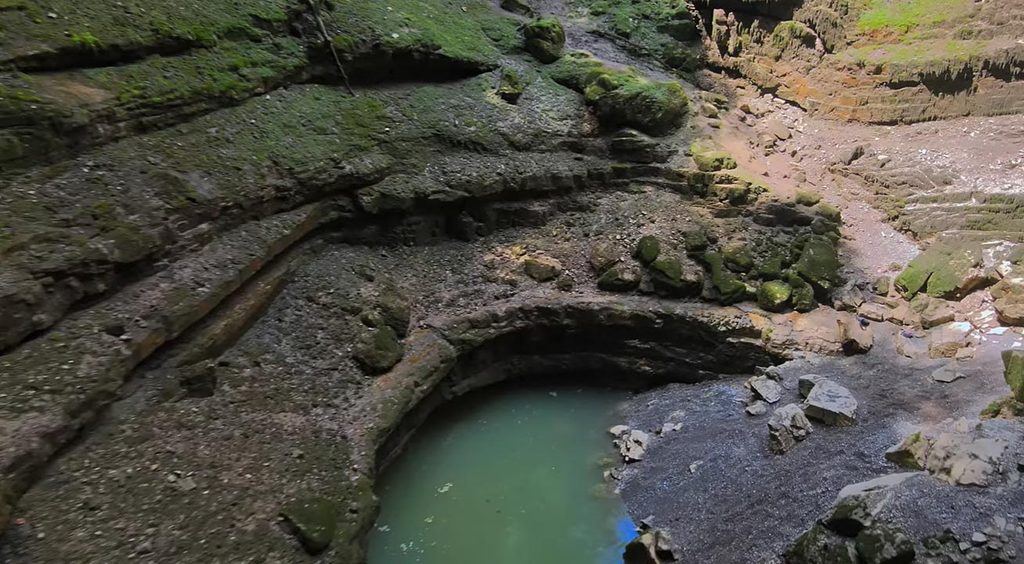
Despite often being described as a lake, Bobijaško Oko is not an ordinary permanent body of water. It is a karst formation known as an estavelle, an opening in limestone terrain that can act as both a spring and a swallow hole.
This unusual behaviour is connected to the underground water system beneath the surrounding landscape.
When underground water levels rise, particularly after heavy rainfall, water can emerge through the opening and fill the depression. At higher levels, it may overflow and flow across the surrounding ground.
When water levels fall, the opposite happens. Water drains through the opening into the underground karst system, revealing more of the rocky depression and its steep sides.
This explains why photographs of Bobijaško Oko taken at different times can look surprisingly different. Sometimes it appears as a small, deep pool surrounded by exposed rock. After periods of heavy rain, it can become a much larger body of water.
The formation is connected to underground waterways in the wider Lušci Palanka area, with water travelling through the karst system towards the sources of the Dabar and Zdena rivers.
The Underground Water System and Human Fish
One of the most interesting aspects of Bobijaško Oko is the wildlife associated with its underground waters.
The underground aquatic environment is home to the olm, known locally as čovječija ribica or the human fish. This unusual amphibian is native to the underground waters of the Dinaric karst and is adapted to living in darkness.
The olm has pale skin, reduced eyes and a remarkable ability to survive in underground habitats. Its presence is an indication of the ecological importance of the water system beneath Bobijaško Oko.
The underground connections between different water sources are also of scientific interest. The karst landscape allows water to travel through passages beneath the surface, linking places that may appear separate when viewed above ground.
For visitors, this is an important reason to treat the site carefully. Swimming is prohibited, and the water and surrounding formations should not be disturbed. The underground habitat is sensitive, and the olm is a protected species.
What to See at Bobijaško Oko
The main attraction is the unusual water-filled depression itself. Its appearance depends on the water level, so the experience can be different from one visit to another.
At lower water levels, the steep rocky sides and the opening towards the underground system become more visible. When the water rises, the depression fills and takes on the appearance of a small forest lake.
The surrounding woodland adds to the atmosphere. The area is relatively quiet and removed from busy tourist routes, making it a pleasant destination for people who enjoy exploring natural landscapes.
The viewpoint from the surrounding higher ground can also help visitors appreciate why the formation is called an eye. From above, its shape and position within the larger karst depression become easier to understand.
There is no developed visitor centre or extensive tourist infrastructure at the site. The attraction is best approached as a short nature excursion rather than a conventional sightseeing destination.
The Legend of Bobijaško Oko
Like many unusual natural places, Bobijaško Oko has inspired local stories and legends.
One popular tale says that fairies and elves visit the area at night, dancing and playing music in the forest. The mysterious appearance of the water-filled hollow, particularly when surrounded by woodland and mist, has helped keep these stories alive.
There is also a local story about a sheep that supposedly disappeared into the underground opening and was later found at another spring. The tale reflects the long-standing curiosity about the underground connections between the water sources in this part of the karst landscape.
These stories are part of the local folklore rather than documented historical events, but they add another interesting dimension to a visit.
How to Get to Bobijaško Oko
The most practical way to reach Bobijaško Oko is by car. From Sanski Most, follow the regional road R405 in the direction of Lušci Palanka and Bosanska Krupa. Near Lušci Palanka, turn towards the R407a road and continue towards the signposted access to Bobijaško Oko.
The final section involves several kilometres of unpaved road. Published visitor directions describe approximately five kilometres of gravel road before reaching the sign for the attraction. Depending on where you leave your vehicle, there may be another 200 to 400 metres to walk through the countryside.
The approach is not always straightforward. Some sections can be muddy, overgrown or affected by rainfall, and navigation applications may suggest unsuitable local or forest roads. It is worth checking the route in advance and asking local residents for directions if necessary.
A vehicle with good ground clearance may be useful, depending on current road conditions. However, do not assume that a standard navigation route is suitable for every vehicle.
Wear sturdy walking shoes, particularly after rain, as the ground and rocks around the depression can become slippery.
Best Time to Visit Bobijaško Oko
There is no single best time to visit because the water level determines much of the appearance of the site.
During drier periods, the water may retreat, revealing the deeper opening and more of the rocky depression. After heavy rainfall or snowmelt, the water level can rise significantly and fill much of the hollow.
Late spring, summer and early autumn are generally more convenient for reaching the site, when the access roads and walking approach are more likely to be manageable. However, a visit after rainfall may reveal a very different landscape from one during a dry spell.
It is worth checking recent local reports and weather conditions before travelling. High water levels can also make the approach more difficult, so the most dramatic appearance does not necessarily mean the easiest visit.
Other Places to Visit Near Bobijaško Oko
Bobijaško Oko can be included in a wider trip around Sanski Most, a region with several interesting natural attractions.
Dabar Cave
Dabar Cave, or Dabarska Pećina, is another unusual karst attraction in the Sanski Most area. It is associated with the source of the Dabar River and is notable for its underground passages, archaeological discoveries and specialised cave wildlife.
The underground water system is particularly interesting because of the connections between springs and karst formations in the wider region.
Read our separate guide to Dabar Cave to learn more about its geology, history and natural environment.
Bliha Waterfall
Bliha Waterfall, also known as Blihin Skok, is one of the most impressive waterfalls in north-western Bosnia and Herzegovina. It is located near Sanski Most and drops over a rocky cliff into a natural pool surrounded by woodland.
Unlike Bobijaško Oko, which is shaped by underground water movement, Bliha is a surface waterfall and a more familiar type of nature attraction.
The two destinations offer very different experiences and can be included in a wider exploration of the Sanski Most region. See our guide to Bliha Waterfall for more information about the waterfall and its walking route.
Una National Park
For travellers continuing through north-western Bosnia and Herzegovina, Una National Park is another worthwhile destination. It protects parts of the Una River and is known for its waterfalls, clear water and outdoor activities.
The park is farther from Bobijaško Oko and is better planned as part of a longer journey rather than a short local excursion. Our guide to Una National Park covers its main attractions and visitor activities.
Is Bobijaško Oko Worth Visiting?
Bobijaško Oko is a fascinating destination for anyone interested in unusual natural formations and the landscapes of Bosnia and Herzegovina. Its changing water levels, underground connections and distinctive appearance make it different from the country’s better-known lakes and waterfalls.
It is not a developed tourist attraction, and reaching it requires some preparation. Visitors should be ready for an unpaved approach, limited facilities and a short walk through natural terrain.
For travellers exploring the Sanski Most area, however, it offers something genuinely unusual. Combined with Dabar Cave and Bliha Waterfall, it provides another reason to discover the quieter natural attractions of north-western Bosnia and Herzegovina.
Similar info:
 Bliha Waterfall, Bosnia and Herzegovina: A Guide to Blihin Skok
 Dabar Cave, Bosnia and Herzegovina: Exploring Dabarska Pećina and the Dabar River Spring
 Una National Park, Bosnia and Herzegovina: Waterfalls, Rafting and Outdoor Activities
 Jajce, Bosnia and Herzegovina: Waterfalls, Lakes and Historic Attractions